
The vicious circle of sweating and stress (and how to break it)
You feel the tension rising even before anything has happened. A job interview, a presentation, a date. You think about the chance that you'll start sweating, and that very idea makes you nervous. And becoming nervous causes you to actually start sweating. It's a self-perpetuating pattern, and it's one of the most recognisable mechanisms in people who struggle with sweating.
 By Zero·One Redactie
1 July 2026
4 min. reading time
By Zero·One Redactie
1 July 2026
4 min. reading time

How the cycle works
The mechanism unfolds in a series of self-reinforcing steps.
It starts with the thought, or even just the expectation, that a situation could trigger sweating. That thought activates your nervous system, even if nothing physical has happened yet. Your body prepares for a stress response: an increased heart rate, tense muscles, and heightened activity of your apocrine sweat glands, the glands that specifically react to emotion.
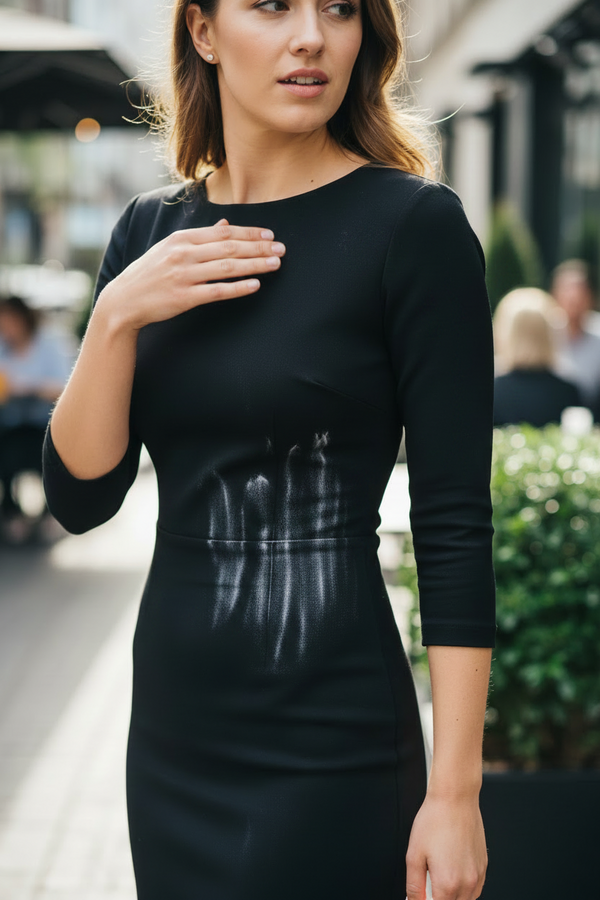
This initial, light sweat reaction is then noticed: you feel it, or you see the beginning of a stain. This observation intensifies the worry ("now it's really happening"), which in turn causes more stress, leading to more sweat. By the time the actual situation begins, you are already in the midst of a built-up stress response.
The pattern feeds itself: the more you sweat, the more you notice it, the more stress it causes, the more you sweat.
Why this pattern is so persistent
What makes this mechanism difficult is that the usual reaction, namely consciously intending "just not to sweat," backfires. Consciously trying to suppress a physical reaction demands mental energy and attention, which in itself is a form of stress. You are thus feeding the very mechanism you are trying to avoid.
Additionally, an avoidance pattern often arises: situations where you have previously sweated, such as a specific meeting room or a certain type of shirt, become associated with the fear of recurrence. This makes the next similar situation extra charged.
How to break the cycle
There is no single trick that solves the pattern all at once, but a combination of approaches helps to weaken the cycle.
One wipe. Up to five days dry.
Discrete anti-perspirant wipes, individually wrapped in a plastic-free sachet. Apply in the evening, ready for the next day.

Shift your focus to your breathing
When you notice tension rising, consciously direct your attention to slow, deep breathing: inhale slowly through your nose, exhale even more slowly through your mouth. This activates your parasympathetic nervous system, the part that helps your body calm down, and interrupts the build-up of the stress response before it fully gets going.
Prepare, instead of hoping everything will be fine
Uncertainty fuels stress. The better prepared you are for a conversation, presentation, or situation, the less room there is for the spiral of "what if I start sweating." This doesn't mean preparation eliminates nerves, but it reduces the unpredictability that reinforces the stress response.
Take the physical aspect out of the equation
A large part of the cycle revolves around the fear of the visible consequence: a wet stain, a clammy handshake. If you know that your armpits or hands already have protection, an important part of the trigger disappears. You no longer have to worry about whether it will become visible, which simply means there is less to worry about.
This is precisely why an evening routine with a long-lasting product can be so effective against this specific mechanism. The Zero·One anti-sweat wipes are applied the evening before an important moment, so that on the day itself you no longer have to think about protection. This certainty, knowing that it's already taken care of, removes part of the impetus for the stress response itself.
Reframe your thoughts about sweating
Instead of thinking "I mustn't sweat," which creates pressure and anxiety, it helps to acknowledge: "sweating is a normal bodily reaction, and I have it under control." This shift reduces the mental burden of the situation, which in turn can alleviate the physical reaction.
Gradually build up exposure
If certain situations, such as presentations or social gatherings, systematically cause anxiety, gradually practicing in less charged versions of that situation (e.g., a short presentation for a small, familiar audience) can help to weaken the association between that situation and stress.
When is professional help a good step?
If the fear of sweating significantly limits your daily functioning, for example if you actively avoid social situations or experience a major impact on work or relationships, a conversation with a doctor or psychologist can be helpful. For some people, anxiety and sweating can become so intertwined that a targeted approach, such as cognitive behavioral therapy, provides more relief than just practical measures.
Frequently asked questions
Why do I sweat more when I'm nervous, even without heat? Your apocrine sweat glands respond specifically to emotion and stress, regardless of ambient temperature. This is a different mechanism than sweating due to heat or exertion.
Can I learn not to sweat from stress? Completely stopping is not realistic, as this is a normal bodily reaction. However, you can reduce the intensity and frequency by breaking the cycle with breathing, preparation, and eliminating physical uncertainty.
Does it help to bring a towel or extra clothes beforehand? This can feel reassuring, but it can also perpetuate the vicious cycle because it keeps attention on the possibility of sweating. A structural approach that already reduces the chance of visible sweating beforehand often works better for breaking the pattern.
Is anxiety sweat different from regular sweat? The underlying sweat is the same, but the trigger and the glands that produce it differ: anxiety sweat primarily comes from the apocrine glands and may have a slightly different odor than sweat due to heat or exertion.
Can therapy help with stress-related sweating? Yes, for people where anxiety and sweating are strongly intertwined, cognitive behavioral therapy or a similar approach can help break the pattern.

Stay dry. And in the loop.
Practical tips on sweat and skin, plus an occasional offer. No spam, you can unsubscribe at any time.